


Industry News

Industry News


The charm of magnetic core materials: the key to optimal performance of electronic devices
 2025-11-26
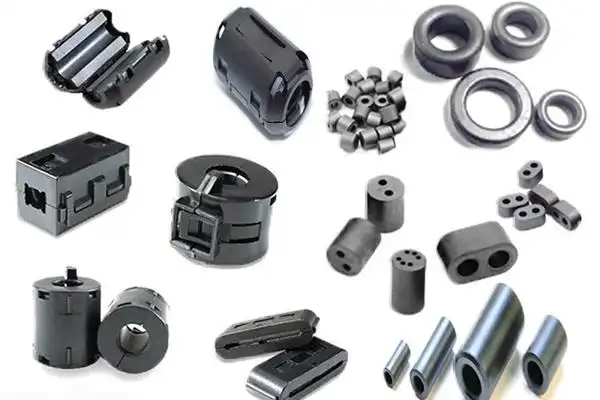
I. Introduction to magnetic core materials
1: Definition and composition of magnetic core
The magnetic core, an element that plays a crucial role in the electronics industry, is a sintered magnetic metal oxide composed of iron oxide mixtures. Its presence enables coils and transformers in electronic devices to operate more efficiently and stably. Typical magnetic core materials include nickel-zinc ferrite and manganese-zinc ferrite, each with its own characteristics, providing a variety of options for the development of electronic devices.
2: Characteristics of magnetic core materials
The characteristics of magnetic core materials determine their application effects in electronic devices. Taking manganese-zinc ferrite as an example, it has the characteristics of high magnetic permeability, high magnetic flux density, and low loss, which make it perform well in high-frequency applications. On the other hand, nickel-zinc ferrite has the characteristics of high impedance and low magnetic permeability, which makes it perform better in some specific applications.

3: Application of magnetic core
Magnetic cores are widely used in electronic devices, primarily for coils and transformers in various electronic equipment. Their function is to enhance the efficiency of coils and transformers, reduce energy loss, and ensure stable operation of electronic devices. It can be said that magnetic cores are an indispensable part of electronic equipment.
II. Types and characteristics of magnetic core materials
1: Iron powder core
Iron powder core, a magnetic core material primarily composed of iron oxide, offers a relatively low price, making it advantageous in scenarios where cost is a concern. With a saturation magnetic induction intensity of approximately 1.4T and a magnetic permeability ranging from 22 to 100ui, it boasts good stability and excellent DC current superposition performance, albeit with high high-frequency consumption. These characteristics render iron powder core suitable for specific applications.

2: Mn-Zn type
The composition of Mn-Zn magnetic core materials includes 70% Fe2O3, 17% MnO, and 13% ZnO. This material has strong conductivity and generally requires coating insulation, which is usually green. It is prone to magnetic saturation, with an inductance range generally above 30%, and is significantly affected by external temperature and pressure. When making samples, we usually set the inductance to XXuH MIN. If the customer has specific requirements for the inductance range, we must use self-drying adhesive to fix the BASE or spacer, and remember not to bake it.

3: Ni-Zn ferrite
The main component of Ni-Zn ferrite is ferric oxide, composed of trace elements such as a small amount of zinc oxide, nickel oxide, copper oxide, and cobalt oxide. It has stable characteristics and low variability. It is usually not painted and requires impedance measurement, i.e., Z value. Sometimes it needs to be sensed. Our factory does not use many Ni-Zn magnetic rings, and the main suppliers are usually BEAD Youci for types such as RH, R6H, and RID. They are generally painted green, following the same color as MN-ZN materials, so care should be taken to distinguish them. Their surface impedance is high, making them electrical insulators for EMI anti-magnetic interference (low impedance at low frequencies, high impedance at high frequencies). Ni-Zn materials generally have low saturation magnetic flux density (BS) and high coercivity (HC), and cannot withstand high currents and significant hysteresis losses.
4: MPP CORES iron-nickel-molybdenum metal magnetic powder core
MPP CORES iron-nickel-molybdenum metal magnetic powder cores are composed of 81% Ni, 2% Mo, and Fe. Their main features include a saturation magnetic induction intensity of approximately 7500Gs, a wide range of magnetic permeability from 14 to 550, minimal loss in powder cores, excellent temperature stability, and widespread application in space equipment, outdoor equipment, etc. The magnetostriction coefficient is close to zero, ensuring no noise when operating at different frequencies.

III. Comparison Table of Magnetic Core Materials
The existence of a magnetic core material comparison table allows us to more intuitively understand the performance of various magnetic core materials, enabling us to make more appropriate choices. Manganese-zinc ferrite, characterized by high magnetic permeability, high magnetic flux density, and low loss, is suitable for applications where high magnetic permeability and magnetic flux density are required. On the other hand, nickel-zinc ferrite, with high impedance and low magnetic permeability, is suitable for applications where high impedance is required.
In general, the selection of magnetic core materials needs to be determined based on specific application scenarios and requirements. Different magnetic core materials have different characteristics, and only by choosing the right magnetic core material can electronic devices achieve optimal performance.